

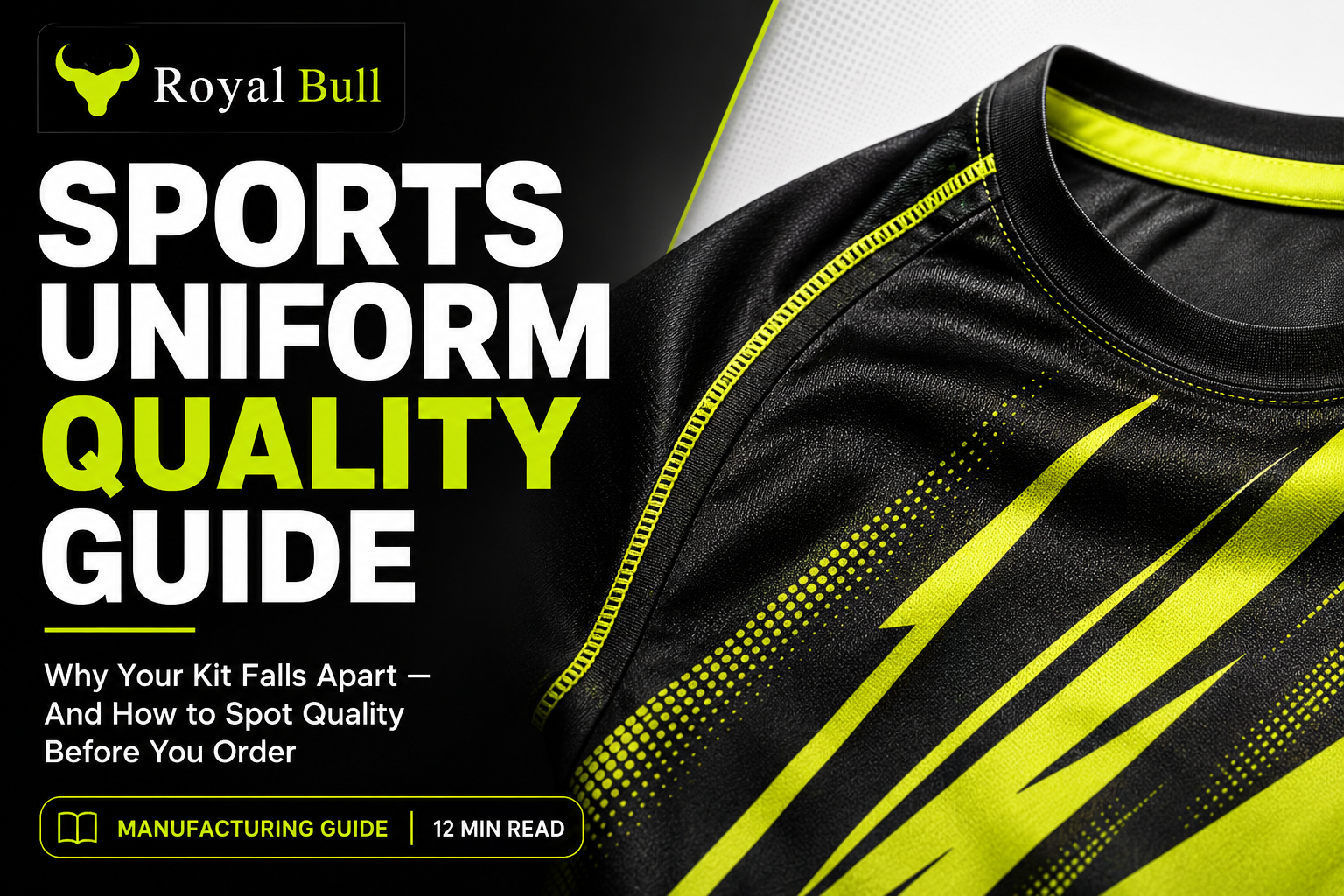
You ordered a full set of custom sports uniforms. They looked good on delivery. Six months later, the seams are splitting. The badge is cracking. The colours have faded to a fraction of what they were on day one. This is not bad luck — it is the predictable outcome of a poorly constructed uniform. This guide explains exactly what separates a kit that lasts two or three seasons from one that fails in six months — and gives you a practical checklist to verify quality before you commit to a bulk order.
The real reason sports uniforms fail early
Most buyers blame the fabric when a uniform fails prematurely. In most cases, the fabric is not the problem — the construction is. A sports uniform is only as strong as the weakest point in its build, and that weakness almost always shows up first at the seams, at the print interface, or at high-stress attachment points like armhole joins and side panels.
The sports uniform market contains an enormous range of quality — from professionally engineered performance garments built to last three seasons of intensive use, to cheaply assembled products designed to look acceptable in photographs but fail within months of real-world play. The difference is rarely visible to the naked eye on delivery. It becomes visible in use.


Stitching — the most important quality indicator in any sports uniform
Stitching is the single most reliable indicator of a sports uniform’s construction quality. It is also the easiest to verify on a physical sample — and the most frequently overlooked by buyers focused on design and price.
Stitch count — the standard you need to know
Professional-grade sports uniforms are constructed at a minimum of 12 to 14 stitches per inch on all primary seams. At 14 stitches per inch with a double lockstitch construction, a seam can withstand the tensile stress of competitive play, repeated stretching, and intensive washing for two to three full seasons without thread breakage or seam separation.
Below 10 stitches per inch — which is where most budget uniform suppliers operate — seams begin to yield under the flex stress of competitive sport within weeks of regular use. The seam does not snap immediately. It gives progressively, creating a gap that widens with every match until the uniform is unwearable.
Stitch type — double lockstitch vs chainstitch
Double lockstitch is the construction method used in all professional sports uniforms. Two threads interlock at every stitch point — if one thread breaks, the stitch holds because the second thread remains locked. A single thread break does not cascade into seam failure.
Chainstitch uses a single looping thread. It is faster and cheaper to produce. It is also fundamentally less reliable — a single thread break at any point can cause the entire seam to unravel progressively from that point. Chainstitching has no place in competitive sports uniforms.
Flatlock stitching at contact points
At seam points that sit against the skin — armholes, collar joins, and inner leg seams — the quality of stitching affects player comfort as much as durability. Flatlock stitching creates a flat seam surface with no raised ridge to chafe against skin during sustained movement. All Royal Bull uniforms use flatlock construction at all body-contact seam points as standard.
Reinforcement at stress points
The armhole, the side seam join at the hem, and the collar attachment are the three highest-stress points in a sports jersey. Quality construction applies bar tacking — a concentrated reinforcement stitch — at each of these points. On a physical sample, you can feel this as a denser, stiffer area of stitching at each join. Its absence on a budget uniform is one of the most reliable indicators of poor construction overall.
Fabric — what the specifications actually mean
GSM — grams per square metre
GSM is the primary measurement of fabric weight in sports apparel. The common assumption — heavier fabric equals better quality — is incorrect for performance sports uniforms. For football, soccer, basketball, and cricket kits, 140 to 160 GSM lightweight performance polyester is the correct specification. It provides the optimal balance of breathability, moisture management, and durability without adding unnecessary weight that restricts movement and traps body heat.
Fabrics above 180 GSM are appropriate for training jackets and outerwear — not match-day performance kits. Fabrics below 130 GSM are too light to hold sublimation printing at full colour saturation and will pill and thin faster under regular washing.
Moisture-wicking construction
True moisture-wicking fabric uses a specific fibre construction — typically a combination of fine-denier polyester with a capillary structure that draws sweat away from skin to the outer surface where it evaporates. This is different from simply labelling a fabric “breathable.” A fabric that claims moisture-wicking performance should be tested on a physical sample: apply water to the inner surface and observe how rapidly it spreads and migrates to the outer surface.
Polyester vs blends — why 100% polyester wins for sport
Cotton-polyester blends retain moisture. A 65/35 poly-cotton blend holds approximately three times more moisture than 100% performance polyester — meaning a player wearing a blend jersey will carry significantly more sweat weight over the course of a 90-minute match. For competitive sport, 100% performance polyester is always the correct fabric choice. Cotton blends belong in casual training wear, not match-day uniforms.


Printing quality — the difference between sublimation and everything else
The printing method used on a sports uniform determines not just how the uniform looks on delivery — it determines how it looks after 50, 100, and 300 washes. This is where the quality gap between manufacturers is most stark and most consequential.
| Method | Durability | Colour Range | All-Over Print | Best For |
|---|---|---|---|---|
| Sublimation | 300+ washes | Unlimited | Yes | All sports uniforms |
| Screen Print | Cracks within months | Limited spot colours | No | Casual wear only |
| Heat Transfer | Peels under washing | Limited | No | Not recommended for sport |
| DTG Print | Moderate — 50–80 washes | Full colour | Limited | Cotton casual wear |
Sublimation printing is the only method that permanently bonds ink into the polyester fabric at a molecular level. There is no surface layer — meaning there is nothing to crack, peel, or fade. The colour saturation at delivery is maintained through the entire life of the garment. All Royal Bull sports uniforms are produced using sublimation printing as standard. No exceptions, across every sport.


How to inspect a sports uniform for quality — the practical checklist
This checklist is designed for use when evaluating a physical sample before approving a bulk order. Every serious manufacturer will produce a sample — and you should use the sample to run every check on this list before signing off on production.
- ✓Count stitches per inch on the main side seam. Hold the seam against a light source. Count the stitch points in one inch. A minimum of 12 — ideally 14 — is the professional grade benchmark.
- ✓Pull test the seam. Hold both sides of a main seam and pull firmly. A quality double lockstitch seam will show minimal give and return to shape immediately. Any visible thread separation is a fail.
- ✓Check for bar tacking at stress points. Run your thumb across the armhole join, the side seam at the hem, and the collar attachment. You should feel a denser, stiffer reinforcement at each point.
- ✓Check the inner seams for flatlock construction. At armhole and collar joins, the seam surface should be flat with no raised ridge. A raised ridge is a chafe point — and a sign of cheaper construction.
- ✓Test the print surface. Run your fingernail across the badge and any printed area. On sublimation printing, there is no raised surface — the print is flat with the fabric. Any texture, ridge, or raised edge indicates screen printing or heat transfer.
- ✓Wash the sample three times and re-inspect. After three machine washes at the temperature specified for match kit, re-run the visual checks. Colour saturation should be unchanged. Seams should show no signs of give. Print surface should be identical to pre-wash condition.
- ✓Test moisture-wicking performance. Apply a small amount of water to the inner surface of the fabric. Quality performance polyester will draw the moisture through to the outer surface within 30 to 60 seconds. Slow migration or surface pooling indicates low-quality fabric.
- ✓Check hem and cuff finishing. All hem and cuff edges should be clean, even, and consistent in width. Uneven finishing is a reliable indicator of inconsistent quality control across the production run.
Print, fabric and wash inspection
How Royal Bull builds quality into every uniform
Every Royal Bull sports uniform is manufactured to the following construction standards — applied consistently across all sports, all order sizes, and all markets:
- ✓14 stitches per inch on all primary seams using double lockstitch construction
- ✓Flatlock stitching at all body-contact seam points — armhole, collar, and inner leg
- ✓Bar tacking reinforcement at all high-stress attachment points
- ✓140 to 160 GSM performance polyester with Quick-Dri moisture-wicking construction
- ✓Sublimation printing only — no screen printing, no heat transfer, no DTG on performance uniforms
- ✓Physical sample produced and approved before every bulk order goes into production
- ✓Multi-stage quality inspection during and after production before shipping
These standards apply to every uniform Royal Bull manufactures — from soccer and cricket to basketball, baseball, American football, and ice hockey:
Common mistakes buyers make when assessing uniform quality
- Judging quality from photographs. A uniform can look excellent in a product photograph and fail within weeks of use. Construction quality is invisible in images — it is only verifiable through a physical sample.
- Accepting “breathable” without testing it. Every supplier claims breathability. True moisture-wicking performance is measurable on a sample — apply water to the inner surface and time how quickly it migrates to the outer surface.
- Not washing the sample before approving. Colour fastness, seam integrity, and print durability all show their real quality after washing — not on delivery. Always wash a sample a minimum of three times before approving bulk production.
- Assuming higher price equals better construction. Price and construction quality do not always correlate. Some high-priced suppliers use screen printing and low-stitch-count seams. Use the physical checklist — not the price point — to assess quality.
- Ignoring the inner seams. Buyers typically inspect the outer surface of a uniform. The most reliable quality indicators — stitch count, seam type, bar tacking, flatlock construction — are all on the inside. Always turn the sample inside out before inspecting.
- Skipping the pull test. A seam that looks clean can still fail under stress if stitch count is insufficient. The pull test takes ten seconds and reveals the real strength of the construction immediately.
Frequently asked questions
A professionally constructed sports uniform should have a minimum of 12 to 14 stitches per inch on all primary seams. At 14 stitches per inch with a double lockstitch construction, a seam can withstand the tensile stress of competitive play and intensive washing for two to three full seasons.
Sublimation printing bonds ink permanently into the polyester fabric at a molecular level — colours cannot crack, peel, or fade regardless of washing frequency. Screen printing sits on top of the fabric surface and degrades under intensive washing and flex stress. All Royal Bull sports uniforms use sublimation printing as standard.
Ordering and delivery questions
For football and soccer kits, 140 to 160 GSM lightweight performance polyester provides the best balance of breathability, durability, and moisture management. Heavier fabrics are not better for performance sportswear — they trap heat and restrict movement.
Request a physical sample before committing to bulk production. Key checks: count stitches per inch on the main seam, pull the seam firmly to test tensile strength, check for bar tacking at stress points, run a fingernail across the print surface to confirm sublimation, and wash the sample three times to test colour fastness and seam integrity.
A properly constructed custom sports uniform using sublimation printing, performance polyester, and reinforced double lockstitch seams should last a minimum of two to three competitive seasons under regular match and training use — including intensive weekly washing.
Yes. Royal Bull manufactures and ships physical samples for evaluation before any bulk order deposit is required. This allows buyers to run the full quality checklist — stitching, fabric, print surface, and wash test — before committing to full production.